How to use a poker solver
A solver shows how a spot should be played against an opponent who plays it perfectly. This guide walks one real hand from the preflop raise to the turn: describing the spot, reading the answer for a whole range, and leaving with one rule for the table.
What a solver gives you, and what it doesn't
A solver searches for an equilibrium: a strategy for each player that the other cannot beat by playing differently. What it returns is a strategy for every hand in each range, written as frequencies: how often a hand checks, bets each size, calls or folds.
That answer is a baseline, not a prediction. It assumes both players play well. Real opponents don't, and the money at most stakes comes from their mistakes, but you can only see a mistake clearly once you know what the baseline looks like.
The answer is also only as good as what you give the solver. The ranges, the stacks, the pot and the bet sizes it may use all change the result, which is why most of this guide is about setting the spot up and reading it, not about pressing a button.
And it is a tool for study, away from the table. Most poker sites forbid any help during a hand.
Before you open it: one spot, one question
The most common complaint about solvers is the flood of numbers. The cure is to arrive with a question. Take a hand from your last session that you were unsure about, and write down two things before you look at anything:
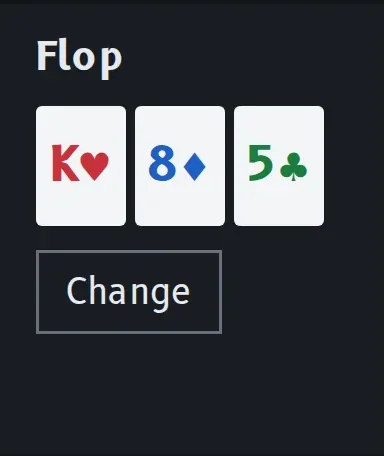
- the question, as narrowly as you can: “the big blind checks to me on K♥ 8♦ 5♣ with KQ suited; what do I do, and with what size?”
- your answer, with a reason: “bet small, because my range has more strong kings than the big blind’s.”
The gap between your guess and the solver's answer is what you study. A spot you guessed right teaches little; a spot you got wrong for a reason you can name teaches a lot.
Choose spots you meet often. A button-versus-big-blind single-raised pot comes up every orbit; a four-bet pot with a 40 bb stack comes up a few times a month. Time spent on the first pays back faster.
Step 1: set up the spot
The screens in this guide come from Gtopilot, a GTO poker solver that runs in the browser, but the steps are the same in any solver.
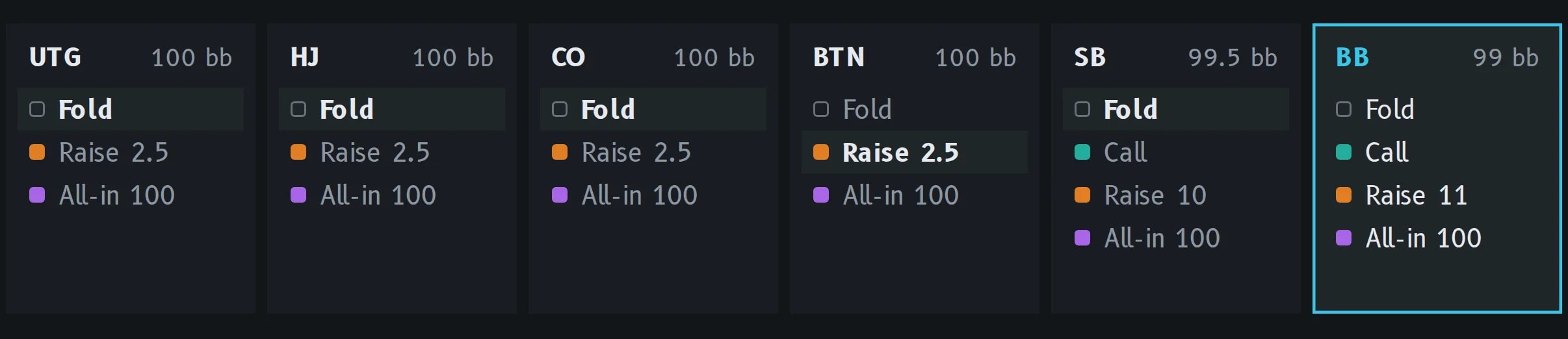
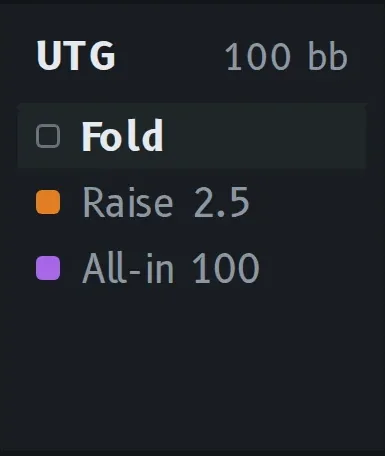
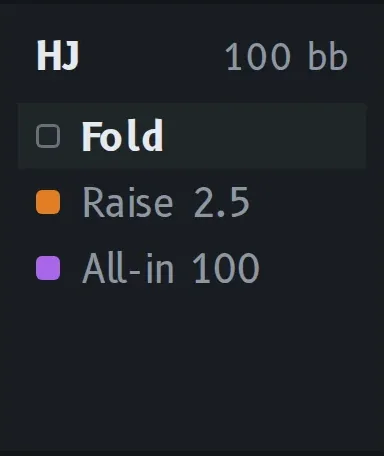
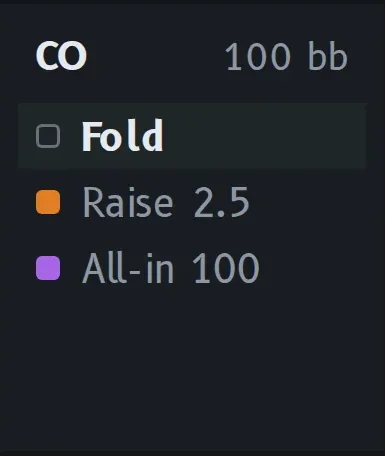
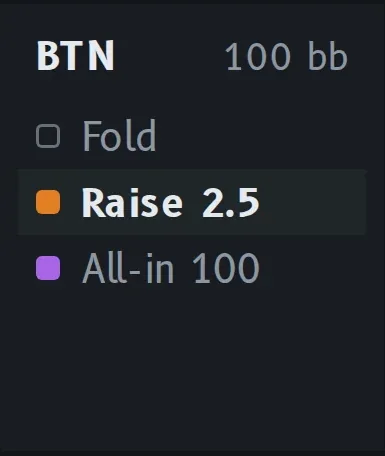
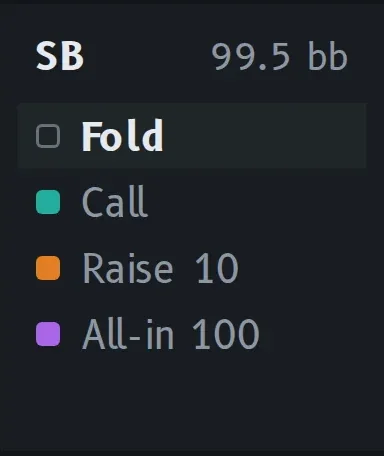
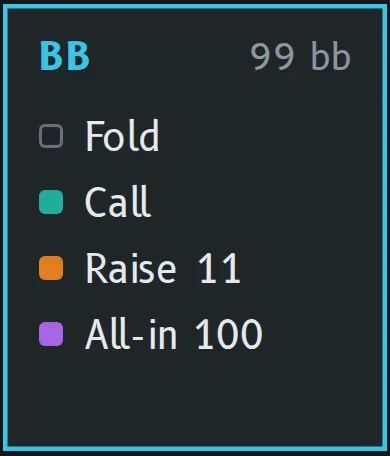
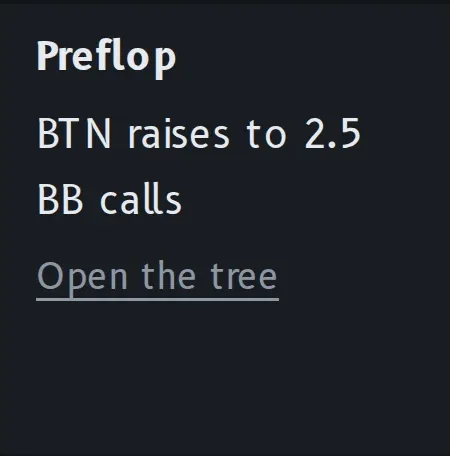
The hand: a 6-max cash game, 100 big blinds deep. It folds to the button, who raises to 2.5 bb. The small blind folds and the big blind calls.
Positions, stacks and preflop ranges
A postflop solve starts from two ranges: every hand each player can hold when the flop comes, each with a weight. The most consistent source is a preflop solution for the same game and stack depth, because the two ranges then fit together: the big blind's calls are exactly the hands it did not fold or 3-bet against this open.
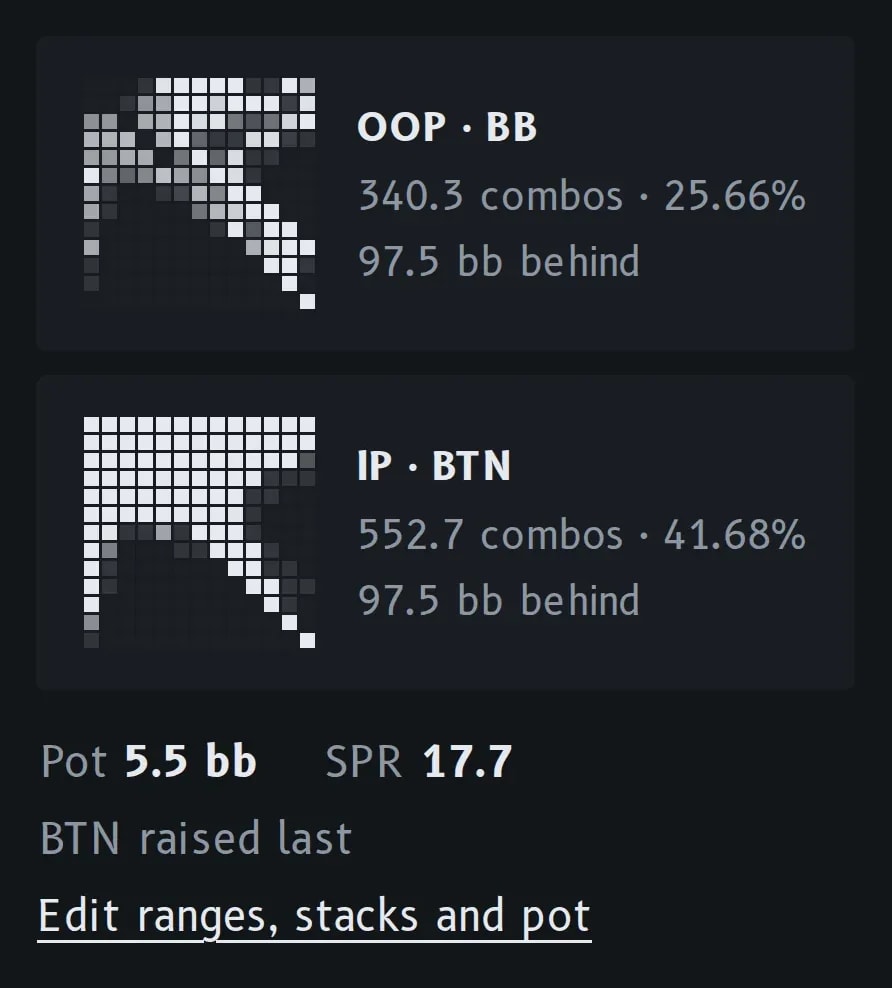
Here the big blind arrives with 340.3 combos, 25.66% of all hands, and the button with 552.7, 41.68%. The decimals are weights: a hand that calls half the time counts as half its combos. The pot is 5.5 bb and each player has 97.5 bb behind, a stack-to-pot ratio (SPR) of 17.7.
Change the ranges when you have a real read, and only then. If your opponent 3-bets every strong hand, their calling range holds none of them, and a chart range that still does gives them hands they never have. In Gtopilot the preflop tree fills both ranges from its charts; changing them by hand, or pasting a range in PioSOLVER or GTO+ format, is the Custom AI screen.
Which bet sizes to include
A solver can only use the sizes you allow. Each size you add makes the game tree larger and the answer slower and harder to read; too few sizes force the strategy into shapes it would not choose. Two or three sizes per decision is the usual starting point, with all-in always available.
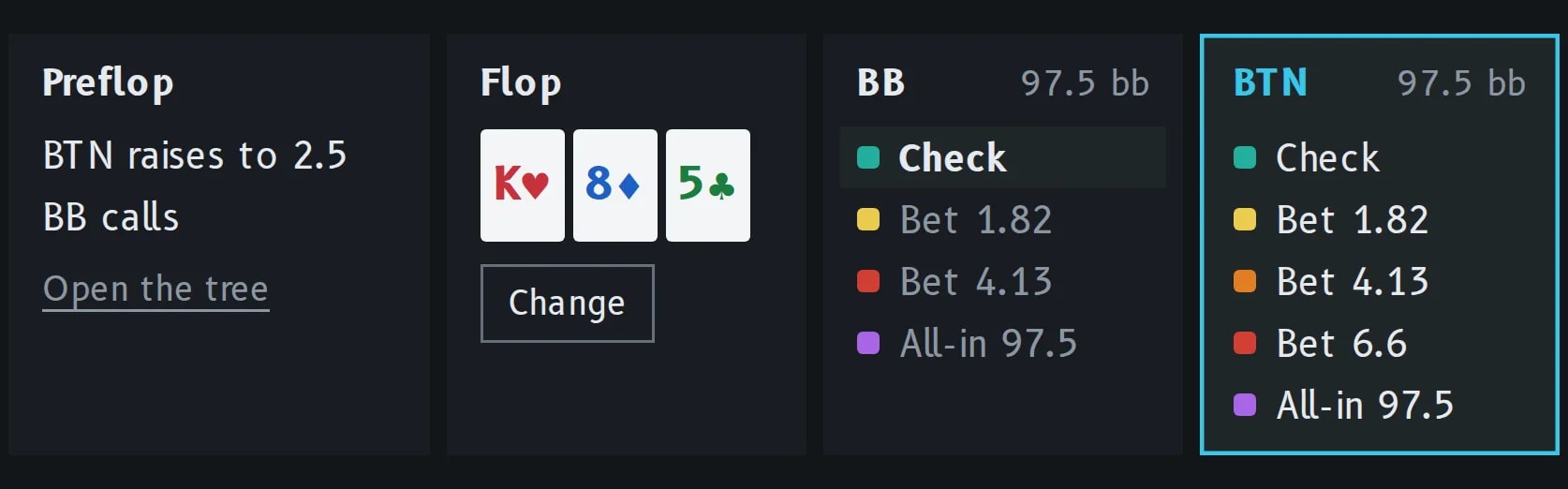
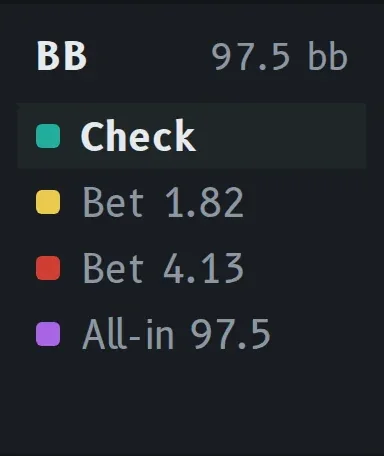
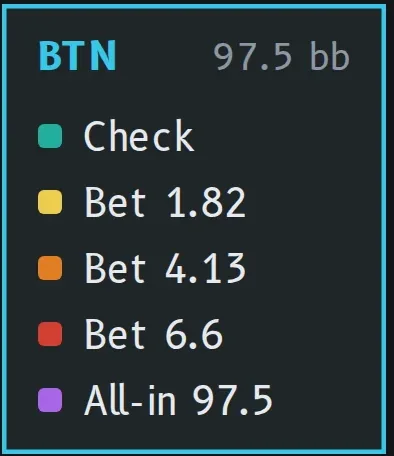
In a desktop solver you choose these sizes yourself before the solve, and the choice is part of the skill. Gtopilot's AI tries sizes from 10% of the pot to all-in and keeps the ones that earn the most; you can also set your own, street by street. On this flop it kept three for the button: 1.82 bb, 4.13 bb and 6.6 bb, a third, three quarters and 120% of the 5.5 bb pot.
Step 2: read the strategy of the whole range
Resist the urge to look up KQs first. Your hand's best play depends on everything else the button holds, so start with the range.
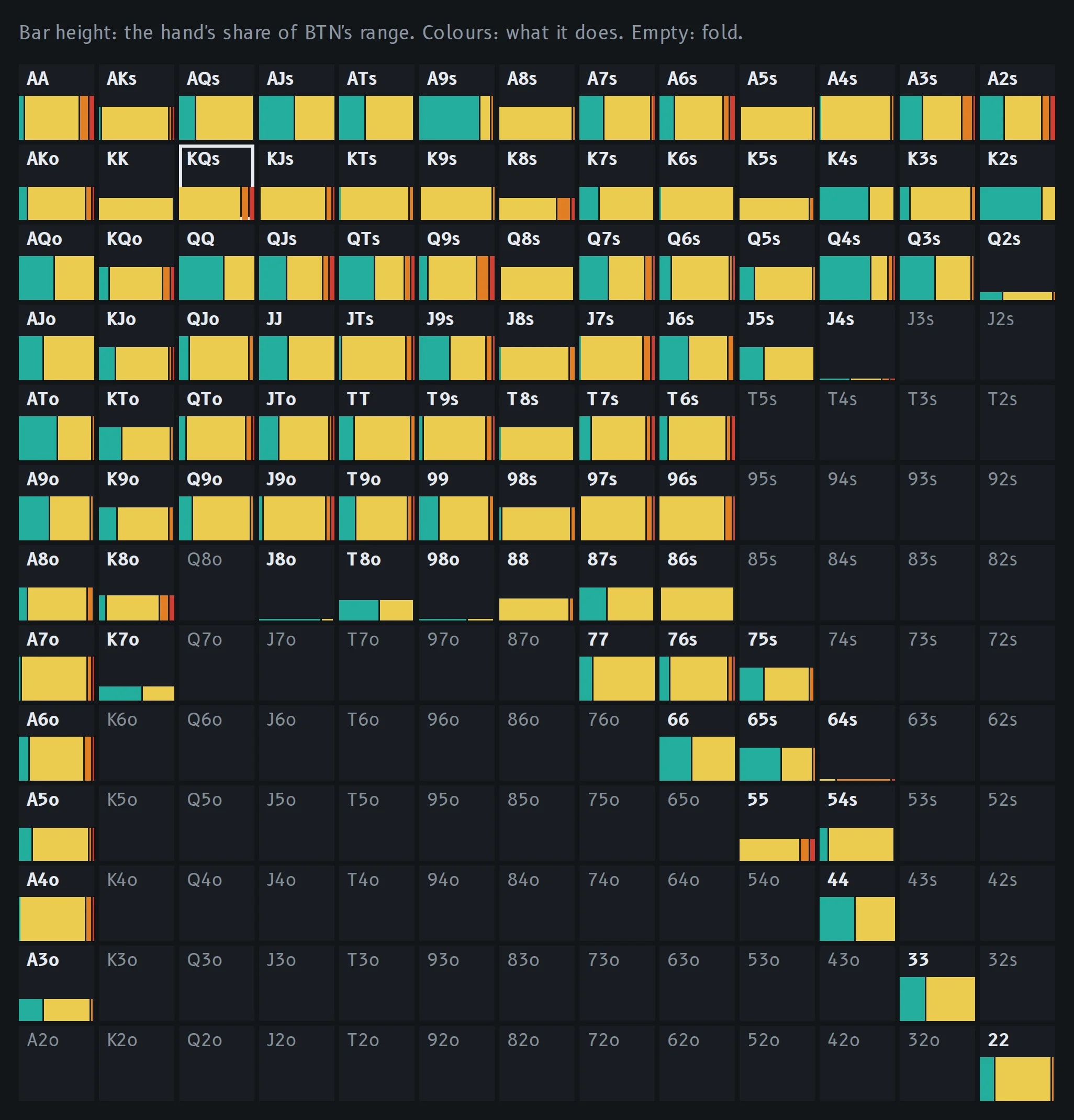
The grid holds the 169 starting hands: pairs on the diagonal, suited hands above it, offsuit hands below. In each cell, colour is the action and the height of the bar is how much of that hand is still in the range. The button cannot fold here, so a short bar means the hand was not always in the range, not that it folds.
Card removal shows too: KK's bar is half height, because the K♥ on the board leaves three of its six combos. It is also why the button's 552.7 combos before the flop are 488 here.
Now read the totals. Across the range the button bets a third of the pot 71.6% of the time and checks 23%; the 75% size takes 3.9% and the 120% size 1.5%. That is close to a range bet: on a dry king-high board the preflop raiser has more strong kings, more AA and more KK than the big blind, so it can bet often, and the size can be small because the big blind's range has few hands that can fight back.
Then look at where the checks sit. They gather in hands with some showdown value that gain little from betting: pairs below the king such as QQ, JJ, 66 and 44, ace-high hands such as AJ, AT and A9, and a few weak kings such as K4s and K2s.
Range frequency and hand frequency
“The button bets 71.6%” is a statement about the range: it bets with most of its hands. It does not mean every hand bets 71.6% of the time. Some hands bet always, some check always, and a few mix. Confusing the two is how players end up flipping mental coins with every hand.
Step 3: go down to hands and combos
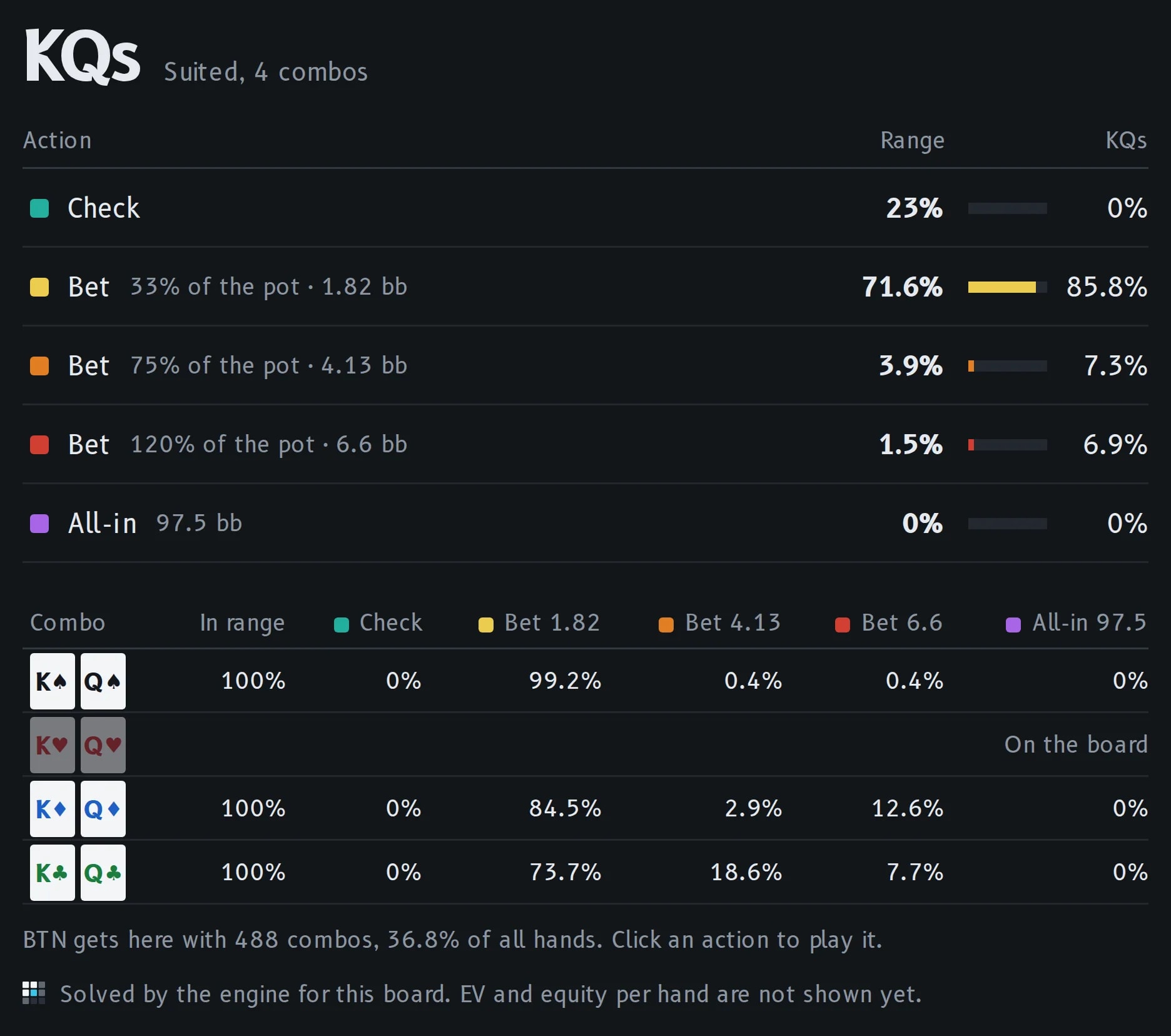
Now KQs. As a hand, it never checks: it bets a third of the pot 85.8% of the time, 75% of the pot 7.3% and 120% 6.9%.
Why suits change the answer
A hand label like KQs stands for up to four combos, and they don't all play the same way. K♠Q♠ bets small 99.2% of the time. K♦Q♦ and K♣Q♣ use the larger sizes more often: each holds a backdoor flush draw, with the 8♦ and the 5♣ on the board, so each has more ways to improve and gains more from a bigger pot. K♠Q♠, with no spade on the board, has none.
The same logic runs through blockers: a combo that holds a card of the hands the opponent continues with makes those hands less likely, and the solver adjusts. Learn the patterns that repeat, like backdoor draws preferring bigger bets, rather than the decimals.
Gtopilot shows combos one by one on its paid plans; the free plan shows each hand as a whole.
What a mixed hand means
When a hand splits between two actions, the solver is telling you both earn about the same. At a perfect equilibrium the actions a hand mixes have exactly the same expected value, which is why it can mix them at all (PioSOLVER's FAQ says so plainly). Real solves are never perfect, so small gaps remain. A mix is not a puzzle to solve; it says the decision is close.
What to do with a mix at the table
Three reasonable approaches, each with its supporters:
- Pick the most frequent action and play it every time. Simple, and it costs little when the actions are close in value. This is the usual advice against weaker players, who will not notice that you never take the other line.
- Split by a feature of the hand: bet the combos with a backdoor draw and check the others, for example. You keep the balance of the range without randomizing.
- Ignore the rare branches. An action taken 1 or 2% of the time is usually noise from the solve, not something to copy.
What you should not do is treat 85.8% as a target to hit. Nobody can, and nobody needs to.
Step 4: follow the hand to the turn
The button bets 1.82 bb and the big blind calls. The turn is the 2♠ and the big blind checks again. The pot is 9.13 bb with 95.69 bb behind.
A blank card, a different strategy
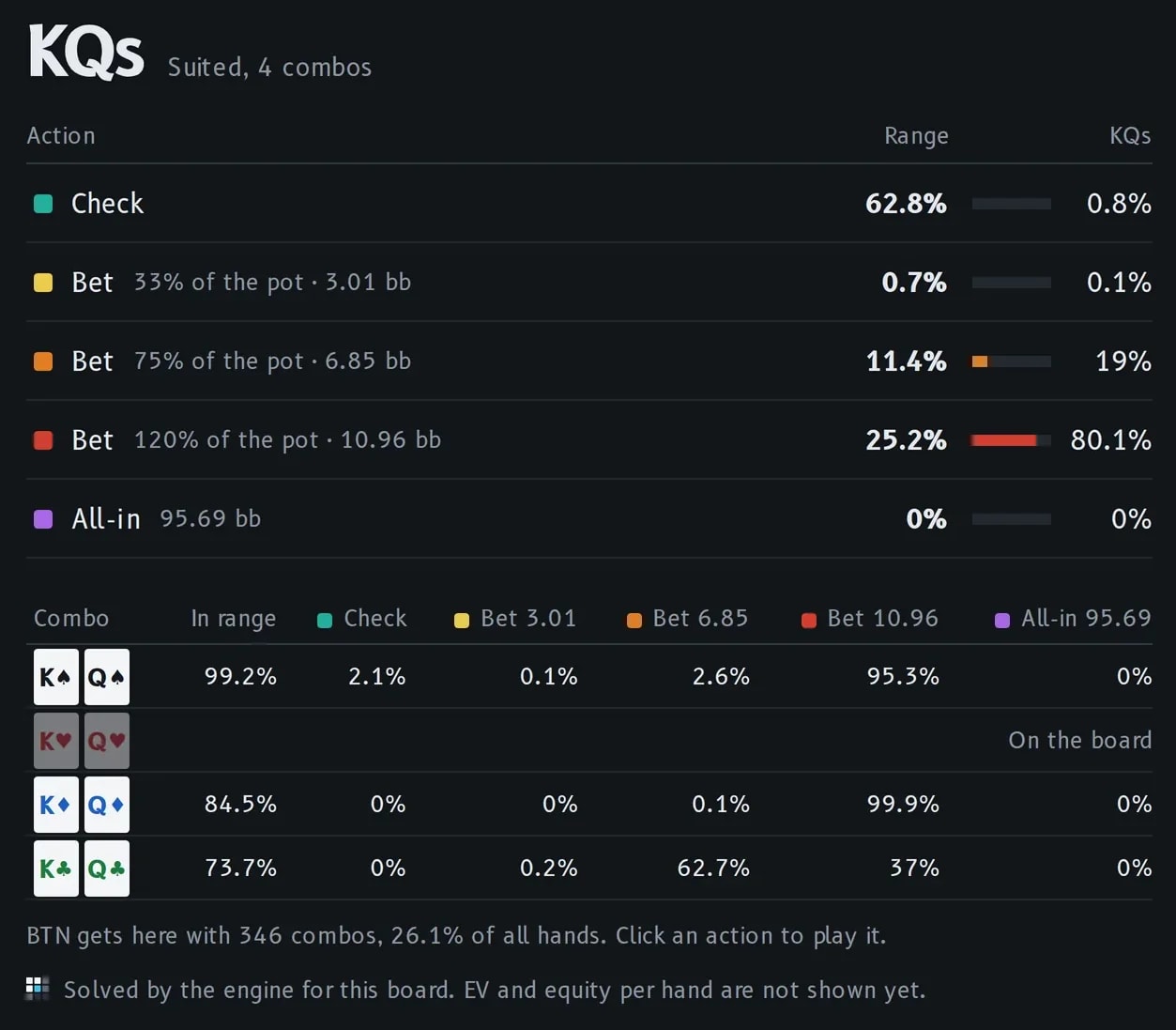
The 2♠ changes almost nothing about who has the best hands: it pairs nothing important and completes no draw. Yet the strategy is very different. The button now checks 62.8% of its range, bets 75% of the pot 11.4% of the time and 120% of the pot 25.2%; the small bet nearly disappears, at 0.7%.
The card did not change; the ranges did. The big blind folded its weakest hands to the flop bet, so the range that called is stronger and harder to push around. The button answers by checking more and, when it bets, betting big: with its strongest hands, such as sets and two pair, with top pair and a good kicker, and with a few draws such as A4o, which has a gutshot to the wheel. KQs bets 120% of the pot 80.1% of the time.
Which combos are still in range
The “In range” column on the turn reads 99.2% for K♠Q♠, 84.5% for K♦Q♦ and 73.7% for K♣Q♣. Those are exactly the shares of each combo that bet a third of the pot on the flop: the rest took another size, so they are on another line. The solver carries every street's choices into the next one, which is why the button now holds 346 combos, 26.1% of all hands, against 488 on the flop.
This is the part most players skip, and it matters: what a range holds on the turn depends on what it did on the flop. Studying a turn in isolation, with ranges that never went through the flop, gives the wrong answer.
Step 5: turn what you read into one rule, then test it
A solve is worth something once it fits in a sentence you can remember at the table. From this hand:
- Flop: button against big blind, single-raised pot, 100 bb, a dry king-high flop checked to the button: bet a third of the pot with most of the range; check some medium-strength hands, such as pairs below the king and ace-high.
- Turn: after the big blind calls, on a blank: check more than half the range; when betting, bet big.
Then test the rule instead of trusting it. Open three or four flops of the same family, such as K♠ 7♦ 2♥ or K♦ 9♣ 4♠, and one that differs on purpose, such as K♥ J♥ T♦, connected and two-tone. If the rule holds on the first group, keep it. Where it breaks, the difference tells you what actually drives the strategy: the connectedness of the board, a flush draw, who has the nut advantage.
Change one thing at a time. Comparing a dry king-high flop at 100 bb with a wet one at 40 bb tells you nothing about either difference.
EV, equity and equity realization
Many solvers also show expected value and equity for each hand. Gtopilot does not show them per hand yet, which is why the screens in this guide show frequencies only, but you will meet them elsewhere, and they are easy to misread.
EV
Expected value is the average result of a hand or an action, in big blinds, measured against a baseline. Tools differ on the baseline (folding is a common zero), so compare EVs only within one node: the EV of checking against the EV of betting, for the same hand at the same moment.
Used that way, EV tells you how much a decision matters. If betting and checking differ by 0.01 bb, either is fine and you can move on. If they differ by 2 bb, that spot deserves your study time. A positive EV does not make an action right, either: it only has to beat zero, while the best action beats every other.
Equity is not EV
Equity is the share of the pot a hand would win if all the remaining cards were dealt with no more betting. It ignores position, the betting to come and how easy a hand is to play. Two hands with the same equity can have very different EV: a suited connector in position keeps more of its equity than an offsuit hand with the same equity out of position.
Equity realization (EQR) measures that difference: roughly, the value a hand gets from the pot is the pot times its equity times its EQR. Strong, easy-to-play hands in position realize more than their equity; weak, awkward hands out of position realize less. It also explains why the hand with the most equity is often not the best bluff: what matters for a bluff is what it makes the opponent fold and what it blocks, not its raw chances.
How accurate is a solve?
A solver improves its strategy over many iterations and stops at a chosen precision; it never reaches perfect play. The usual measure is exploitability, also called Nash distance: how much a perfect opponent could win against the strategy, as a share of the pot. For study, a common target is under half a percent of the pot; GTO Wizard notes that halving that number roughly doubles the solving time.
Two practical consequences. Differences smaller than the solve's precision are not real, which is one more reason to read patterns rather than decimals. And an AI solver adds its own approximation: Gtopilot's engine solves the flop and the turn with a neural network trained by self-play and the river exactly, which is what makes a street take seconds instead of minutes.
Common mistakes
- Studying a spot you don't play. The wrong stack depth, no rake, or chart ranges against an opponent who plays nothing like them: the answer is precise and useless.
- Reading your hand before the range. “KQ bets small” means little until you know that the whole range bets small.
- Memorizing frequencies. 71.6% is not a number to remember; “bet small with most of the range” is a rule you can use.
- Treating every mix as a problem. A mix says two actions are close. Pick one and move on.
- Playing the baseline against players far from it. Equilibrium does not exploit anyone. Against a player who never bluffs the river, folding more of your bluff-catchers earns more than the solver's calls. Know the baseline, then deviate where you have evidence.
- Studying without writing anything down. If a session ends without a rule on paper, it was entertainment.
A 30-minute study routine
- Five minutes: choose. One hand from your last session that felt unclear. Write the spot, the question and your guess.
- Ten minutes: read. Open the spot. Range first, then your hand, then its combos. Compare with your guess and write down where you were wrong.
- Ten minutes: test. Change one thing, another board of the same family or another stack depth, and see whether what you learned survives.
- Five minutes: keep. Write the rule in one sentence, and save the spot so you can check yourself on it next week.

A few sessions like this a week do more than an evening of clicking through trees. The routine works the same way in any solver; what matters is the question at the start and the sentence at the end.
Questions
Do I need to understand GTO before using a solver?
No. A solver is one of the best ways to see what GTO play looks like. Knowing basic preflop ranges and pot odds helps you ask better questions, and that is enough to start.
Is using a solver allowed?
Studying with one between sessions is normal practice. What most poker sites forbid is help during a hand, real-time assistance of any kind, and so do Gtopilot's terms.
Do I need a powerful computer?
For a desktop solver, a large tree needs a lot of memory and time. A solver that runs in the browser, as Gtopilot does, solves on its servers, so any computer will do.
What is node locking?
Node locking fixes one player's strategy at a point of the game tree, for example a player who never check-raises, and lets the solver find the best answer to it. It is how a read becomes a strategy. Gtopilot does not lock nodes; its Custom AI lets you change the ranges each player arrives with, which covers reads about what a player holds rather than how they play it.
Can a solver handle three-way pots?
Most solvers handle two players at a time. With three, equilibrium is harder to compute and there can be several, so read the answer as a strong baseline rather than a guarantee; three-way pots follow habits of their own. Gtopilot solves three-way flops in tournaments and Spins.
Is solver study worth it at low stakes?
Yes, if you spend it on the spots you meet most: single-raised pots, blind battles, c-bets and the defence against them. The aim at low stakes is less to copy equilibrium than to know it well enough to see where your opponents leave it.
Every screen in this guide is a real Gtopilot screen, solved by its engine. To walk one of your own hands the same way, the free plan includes the preflop library, up to a daily limit, and a few AI solves a day; Custom AI and three-way pots come with Ultra. Create a free account.